How Kirkland's Affordable Housing Target Was Set
Kirkland has to plan for 13,200 new homes by 2044. More than half must be affordable to the households with the lowest incomes in the region.
If you have followed any conversation about housing in Kirkland over the last three years, you have heard numbers. Thirteen thousand. Fifty-six percent. Eighty-seven percent.
Almost nobody explains what they are or where they came from. They are worth understanding, because the shape of the requirement, not just its size, is what makes it difficult.
Every city in the county needed a number
Washington's Growth Management Act requires cities to plan for future housing, and not just housing in general. Under House Bill 1220, passed in 2021, cities must plan for homes at specific income levels, including the lowest ones, in their 2044 comprehensive plans.
The state produced the projections. King County then had to divide its share among dozens of cities. That work was done by the King County Affordable Housing Committee and adopted through the Countywide Planning Policies.
The committee developed three methods. Kirkland described each of them in its own letter to the regional body:
Option 1 applied the same share of new housing growth to every jurisdiction. Kirkland's letter said this "does not sufficiently address the fact that much more housing is needed in many job- and opportunity-rich communities."
Option 2 aimed for the same share of total housing stock to be affordable in every jurisdiction by 2044. Kirkland's letter noted it "relies on shrinking affordable housing supplies in certain income brackets" where a city was deemed oversupplied. Under this method, Kirkland's own allocation above 120 percent of median income came out to negative 1,051 units.
Option 3 used weighting factors to raise the allocation in places with fewer affordable options and "greater imbalances of low-wage workers to low-wage jobs."
The region adopted Option 3.
That last factor is worth pausing on, because it is not measured city by city. It is measured across subregions. King County's 2025 assessment puts about 90,000 low-wage jobs in East King County against roughly 66,000 low-wage residents to fill them, which the county describes as a moderate gap. Countywide the figures are about 318,000 jobs against 243,000 workers, and Seattle's gap is larger than the Eastside's, at roughly 123,000 jobs against 70,000 resident workers.
So one of the three factors that shaped Kirkland's individual number reflects a condition across all of East King County rather than anything specific to Kirkland's borders. That is how the method was designed to work. It is also why the resulting number is hard to read as a verdict on Kirkland alone.
What the choice of method changed for Kirkland
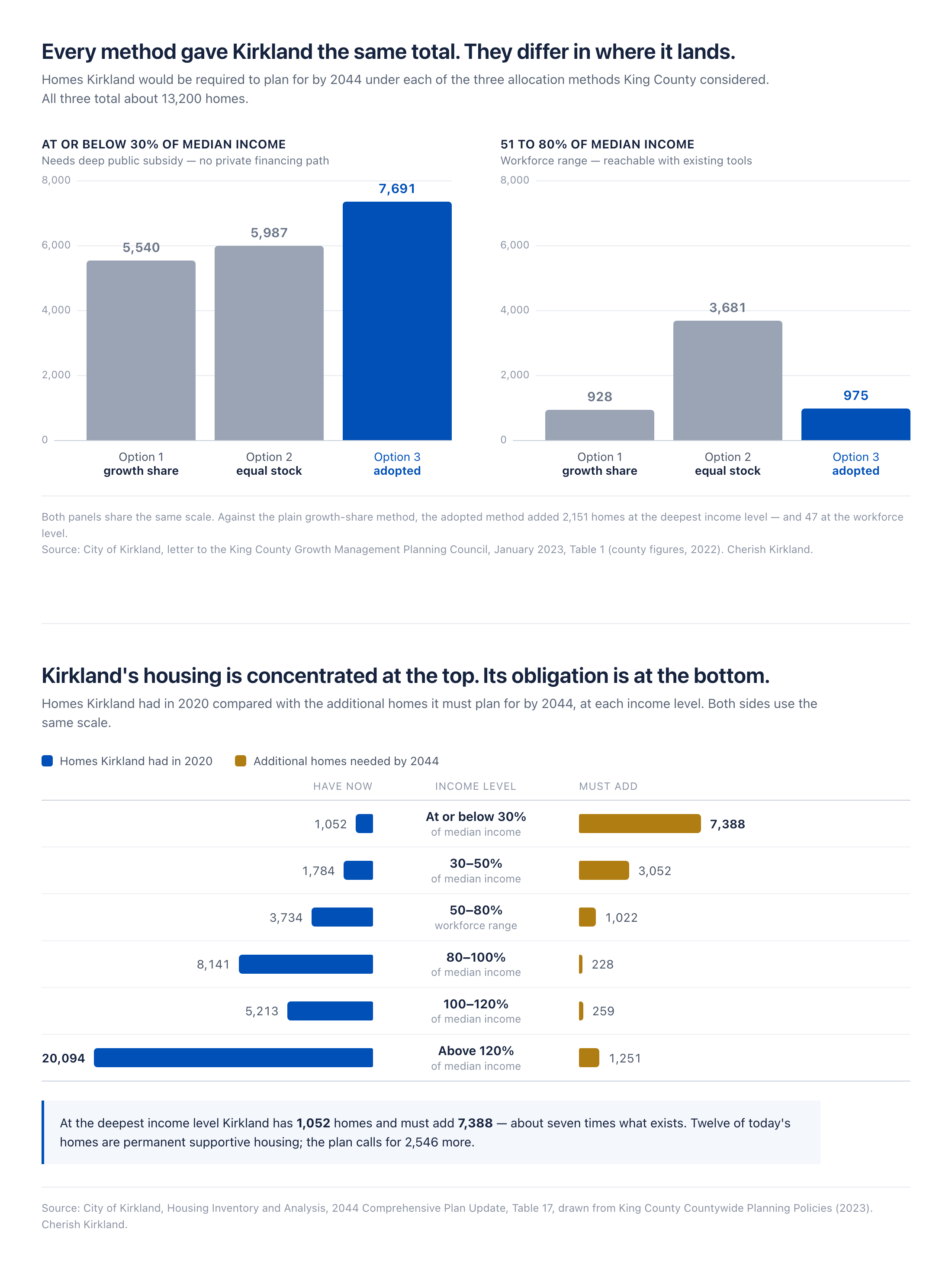
Kirkland's letter put the three options side by side in a single table, using county figures from 2022. Here is the row that matters most.
0–30% AMI — Option 1: 5,540 · Option 2: 5,987 · Option 3: 7,691
31–50% AMI — Option 1: 2,062 · Option 2: 4,072 · Option 3: 3,057
51–80% AMI — Option 1: 928 · Option 2: 3,681 · Option 3: 975
81–100% AMI — Option 1: 614 · Option 2: 48 · Option 3: 194
101–120% AMI — Option 1: 696 · Option 2: 463 · Option 3: 220
Above 120% AMI — Option 1: 3,361 · Option 2: −1,051 · Option 3: 1,063
Total — Option 1: 13,201 · Option 2: 13,200 · Option 3: 13,200
Every option produces the same overall total of about 13,200 homes. What changes is where they sit.
At the deepest income level, the straightforward growth-share method would have assigned Kirkland 5,540 homes. The method the region adopted assigned 7,691. That is 2,151 additional homes, an increase of about 39 percent, and it comes entirely from the equity weighting factors.
Now look one line further down. At 51 to 80 percent of median income, the workforce range, Option 3 asked for 975 homes where Option 1 asked for 928. Almost no difference. The adopted method concentrated nearly all of the adjustment at the one income level where private financing cannot reach.
One note on figures. The table above uses the 2022 county numbers that were in front of the council when it decided. The allocation was finalized afterward in the 2023 Countywide Planning Policies, where Kirkland's 0–30 percent figure settled at 7,388 rather than 7,691. The comparison holds either way; the numbers below come from the final adopted version.
What Kirkland was actually assigned
Kirkland's own 2044 Comprehensive Plan documents lay out the allocation in a single table. Here is what it says.
At or below 30% AMI (permanent supportive housing) — Homes Kirkland had in 2020: 12 · Additional homes needed by 2044: 2,546
At or below 30% AMI (all other) — Homes Kirkland had in 2020: 1,040 · Additional homes needed by 2044: 4,842
30–50% AMI — Homes Kirkland had in 2020: 1,784 · Additional homes needed by 2044: 3,052
50–80% AMI — Homes Kirkland had in 2020: 3,734 · Additional homes needed by 2044: 1,022
80–100% AMI — Homes Kirkland had in 2020: 8,141 · Additional homes needed by 2044: 228
100–120% AMI — Homes Kirkland had in 2020: 5,213 · Additional homes needed by 2044: 259
Above 120% AMI — Homes Kirkland had in 2020: 20,094 · Additional homes needed by 2044: 1,251
Total — Homes Kirkland had in 2020: 40,018 · Additional homes needed by 2044: 13,200
Two rows deserve a second look. Both counts are from 2020, which is when the baseline was measured.
At the 50 to 80 percent level, often called workforce housing, Kirkland had 3,734 homes in 2020 and needs to add 1,022. That is an increase of about 27 percent, and there are existing tools that can help get there.
At 30 percent of median income and below, Kirkland had 1,052 homes in 2020 and needs to add 7,388. That is roughly seven times the 2020 supply. Of those, 2,546 are permanent supportive housing, meaning long-term housing paired with health care and case management for people who have experienced homelessness. In 2020, Kirkland had twelve.
That last figure has changed considerably since. Sheila Stanton Place, the King County Health Through Housing project in the former La Quinta Inn, opened to residents in early 2026 with 101 permanent supportive housing apartments, owned by the county and operated by Plymouth Housing. It arrived well after the 2020 baseline and is not counted in the table above. It is by a wide margin the largest single addition Kirkland has made at this income level.
That 7,388 figure is about 56 percent of Kirkland's entire 13,200-unit requirement. Counting everything at or below 80 percent of median income, the total is 11,462 homes, which is roughly 87 percent of what Kirkland must plan for. Mayor Kelli Curtis cited that obligation to the council at its May 5, 2026 meeting as 11,500 additional homes at 80 percent of median income or below.
What these income levels mean in dollars
Area Median Income, usually shortened to AMI, is calculated each year by the federal Department of Housing and Urban Development and adjusted for household size. King County's 2025 limits look like this.
1 person — 30% AMI: $33,050 · 50% AMI: $55,000 · 80% AMI: $84,850 · Median: $110,000
4 persons — 30% AMI: $47,150 · 50% AMI: $78,550 · 80% AMI: $121,150 · Median: $157,100
So when Kirkland is asked to plan 7,388 homes at or below 30 percent of median income, that means homes affordable to a person earning about $33,000 a year, or a family of four earning about $47,000.
The 50 to 80 percent range, where Kirkland needs 1,022 more homes, covers a single person earning between roughly $55,000 and $85,000.
These limits are recalculated every year, so the figures above are current as of 2025.
Why the shape matters more than the size
The two tiers behave very differently, and this is the heart of it.
Housing in the 50 to 80 percent range can often be produced by the private market with incentives, because rents at that level cover enough of what a building costs.
Housing at or below 30 percent of median income cannot. The gap between what those households can pay and what a unit costs to build has to be closed with public subsidy, layered from federal, state, and local sources that are finite, competitive, and already oversubscribed. Permanent supportive housing is the most expensive category of all, because it carries ongoing services on top of construction.
So Kirkland's requirement asks for a modest increase where the market can reach and a sevenfold increase where it cannot.
Kirkland did not sit this out
It would be easy to assume these targets were handed down and quietly accepted. The council record shows something more deliberative.
On December 13, 2022, the council held a special meeting on whether Kirkland should weigh in with the regional body. Penny Sweet was mayor at the time. Two other cities, Mercer Island and North Bend, had already sent letters opposing the committee's recommendation. Councilmember Kelli Curtis, now Kirkland's mayor, sat on the regional caucus handling the issue, and argued that saying nothing carried its own message.
"I feel like if we stay silent on this issue, we are sending the message that we're in agreement with Mercer Island and North Bend."
She was not uncritical of the letter Kirkland's staff had drafted. She said it needed a preamble and a problem statement, that it "immediately jump[s] into, we support option three," that it was "ponderous," and that she would "lighten the tone a little bit if we're a little on our high horse." She also noted it offered no next steps.
She asked for one thing directly relevant to this article. Mercer Island and North Bend had included their own housing numbers in their letters. Curtis wanted Kirkland to do the same:
"I think it would be worthwhile for Kirkland to include ours so that people see the differences between the three cities."
The two versions of the letter are both in the public record, and the changes are easy to trace. The December 5 draft contained no numbers at all. It opened by stating Kirkland's support for Option 3 in its first sentence, described job-rich communities as "historically exclusionary," and closed with the line "If cities can't step to this challenge, who will?"
The revised letter that went to the council on January 17 opens instead with a paragraph describing the regional housing crisis, moves the statement of support down the page, drops the closing challenge, softens the language about other cities, adds a concrete next step in the form of a proposed joint meeting between the two regional caucuses, and adds Table 1, the comparison of the three options reproduced earlier in this article.
Every one of those changes matches something Curtis asked for on December 13. The table now central to understanding Kirkland's obligation exists because a councilmember asked that residents be able to see the numbers.
Councilmember Amy Falcone, who chaired a separate regional caucus that had reached unanimous support for the framework, was candid about the effort it took: "It took some work and it took some time and it took some collaboration to get to that point." She added that she "wouldn't normally suggest that we send a letter like this," but supported it as a counterweight to the two opposing letters.
Not everyone agreed on timing. Councilmember Jon Pascal cautioned that letter-writing could damage the collaborative process, saying "once you start doing the letter writing, that's when things break down," and asked whether Kirkland could give it more time. Then-Councilmember Toby Nixon, who no longer serves on the council, proposed a middle path: write the letter, but hold it and share it with caucus colleagues first, so it might move the conversation toward agreement rather than harden positions.
A subcommittee of Curtis, Falcone, and then-Deputy Mayor Jay Arnold, who remains on the council, revised it. The council authorized the mayor to sign it on January 17, 2023, ahead of the regional body's January 25 meeting.
The letter supported Option 3. It also said plainly what supporting it would require. From the opening paragraph:
"We also realize that even with best-practice policies and regulations in place, local jurisdictions cannot solve the affordable housing crisis by themselves, and that significant outside investment is needed."
The letter went further, urging the county to write that principle into the Countywide Planning Policies themselves:
"Local jurisdictions can create enabling environments and generate local revenue to support new housing development and housing preservation, but successful implementation requires resources and involvement from other levels of government, nonprofits, and the private sector."
That is the condition Kirkland attached, and it wasn't an aside. Kirkland asked for it to become regional policy.
Where things stand
King County's 2025 Countywide Housing Needs Assessment tracks how much income-restricted housing each city actually delivered between 2019 and 2023. At the deepest tier, the East King County numbers are small.
Bellevue — Homes delivered at 0–30% AMI, 2019–2023: 291
Kirkland — Homes delivered at 0–30% AMI, 2019–2023: 205
Redmond — Homes delivered at 0–30% AMI, 2019–2023: 64
Issaquah — Homes delivered at 0–30% AMI, 2019–2023: 0
Kirkland's 205 homes are against a 2044 requirement of 7,388.
That data was collected through the end of 2023 and predates recent completions in every city listed, not only Kirkland. Two significant Kirkland projects have opened since. Sheila Stanton Place added 101 permanent supportive housing apartments in early 2026. King County Housing Authority's Kirkland Heights held its grand opening in June 2026 with 276 income-restricted homes, though that figure needs a caveat: 180 of those are existing apartments renovated and preserved from redevelopment, and 96 are new. The property averages about 60 percent of median income, the tier where the adopted method asked Kirkland for the least, and 106 of its 276 homes carry King County Housing Authority project-based subsidy, which reaches the lowest incomes.
This is not a Kirkland story. Countywide, the region needs about 7,802 income-restricted homes a year at or below 80 percent of median income. From 2019 through 2023 it averaged 3,472, which King County's own assessment calls "less than half of what is needed." Nearly two-thirds of what did get built landed in the 50 to 80 percent range, not the deepest tier.
The county puts the money gap at $3.96 billion a year in 2025 dollars, combining unmet construction subsidy with the cost of operating and servicing the units.
When every jurisdiction under the same requirement falls short at the same time and by similar margins, the likeliest explanation is a gap between what the method asked for and what the funding environment can deliver, not a failure of local effort in any one city.
What happens next
Two things are ahead.
The countywide policies build in a midpoint review partway through the ten-year planning cycle. At that point jurisdictions report on their progress, and the framework anticipates that cities may be asked to take additional measures if they are falling short. Kirkland will be reporting the numbers above.
Separately, there is early movement toward new funding. On March 31, 2026, King County Executive Girmay Zahilay issued an executive order launching what he called the "Breaking the Cycle" initiative and convening a work group to "explore a dedicated revenue source" for shelter and affordable housing. Reporting at the time indicated that could include a countywide affordable housing levy going before voters as early as 2027.
Nothing has been drafted, and nothing has been placed on a ballot. But if it advances, it would ask Kirkland taxpayers to help close part of the gap these targets depend on.
Our analysis: The conditions Kirkland attached to its support in January 2023 are the right yardstick now. Those conditions said plainly that local government could not deliver these targets alone. Residents are entitled to a clear public accounting of which conditions have been met, which have not, and what that means for the target itself, before any new funding question reaches a ballot. That is not a position for or against the targets. It is asking whether the plan behind them still holds.
Sources & city records
Last updated: August 2026.
City of Kirkland, "Letter to King County Growth Management Planning Council regarding Countywide Affordable Housing Needs," staff memorandum and attached draft letter, December 6, 2022 (council packet, December 13, 2022, Item 10.b.(1))
City of Kirkland, "Revised Letter to King County Growth Management Planning Council regarding Countywide Affordable Housing Needs," staff memorandum and attached letter, January 10, 2023 (council packet, January 17, 2023, Item 10.b.(2)) — Table 1, Kirkland's housing need allocation under Options 1, 2, and 3
City of Kirkland, Housing Inventory and Analysis, Kirkland 2044 Comprehensive Plan Update (Table 17: existing and needed housing units by affordability, sourced to King County 2023 Countywide Planning Policies)
King County Affordable Housing Committee, Draft GMPC Motion 21-1 Countywide Planning Policy Amendments, staff report, October 28, 2022
King County Countywide Housing Needs Assessment, 2025 (Exhibit 51, income-restricted housing delivery by jurisdiction 2019–2023; countywide production rate; annual funding gap; King County income and rent limits for 2025; Exhibit 38, low-wage jobs and resident workers by subregion, drawn from U.S. Census Bureau Longitudinal Employer-Household Dynamics data for 2023)
Kirkland City Council Special Meeting, December 13, 2022 (council discussion and quotations)
Kirkland City Council Meeting, January 17, 2023 (authorization for the mayor to sign the letter)
Kirkland City Council Meeting, May 5, 2026 (Mayor Kelli Curtis on the share of units at or below 80 percent AMI)
Kirkland City Council Meetings, December 9, 2025 and June 16, 2026 (opening of Sheila Stanton Place and six-month assessment); Plymouth Housing, "Celebrating Sheila Stanton Place," July 2026 (101 apartments, owned by King County, operated by Plymouth Housing)
King County Housing Authority, Kirkland Heights grand opening, June 2026 (276 income-restricted homes: 180 renovated and preserved, 96 new; average affordability about 60 percent AMI); King County Housing Authority property listing and aptfinder.org listing (income-averaging property with units at 30, 50, 60 and 80 percent AMI; project-based subsidy on 106 of 276 apartments); Kirkland City Council Meeting, May 5, 2026 (KCHA briefing to council)
King County Executive Order ACO-8-34-EO, "Breaking the Cycle," effective March 31, 2026, convening a work group to explore a dedicated revenue source for shelter and affordable housing
Want to talk about this with neighbors?Join the Cherish Kirkland Facebook group. It's a private community of Kirkland residents; request to join and an admin will approve you.