EXPLAINER · TAXES
Where Your Kirkland Property Tax Goes
How an issue works and who decides it. We keep these up to date. About our labels
Who actually gets your property tax bill, why it keeps rising, and what to know as Kirkland writes its 2027-2028 budget.
In short:
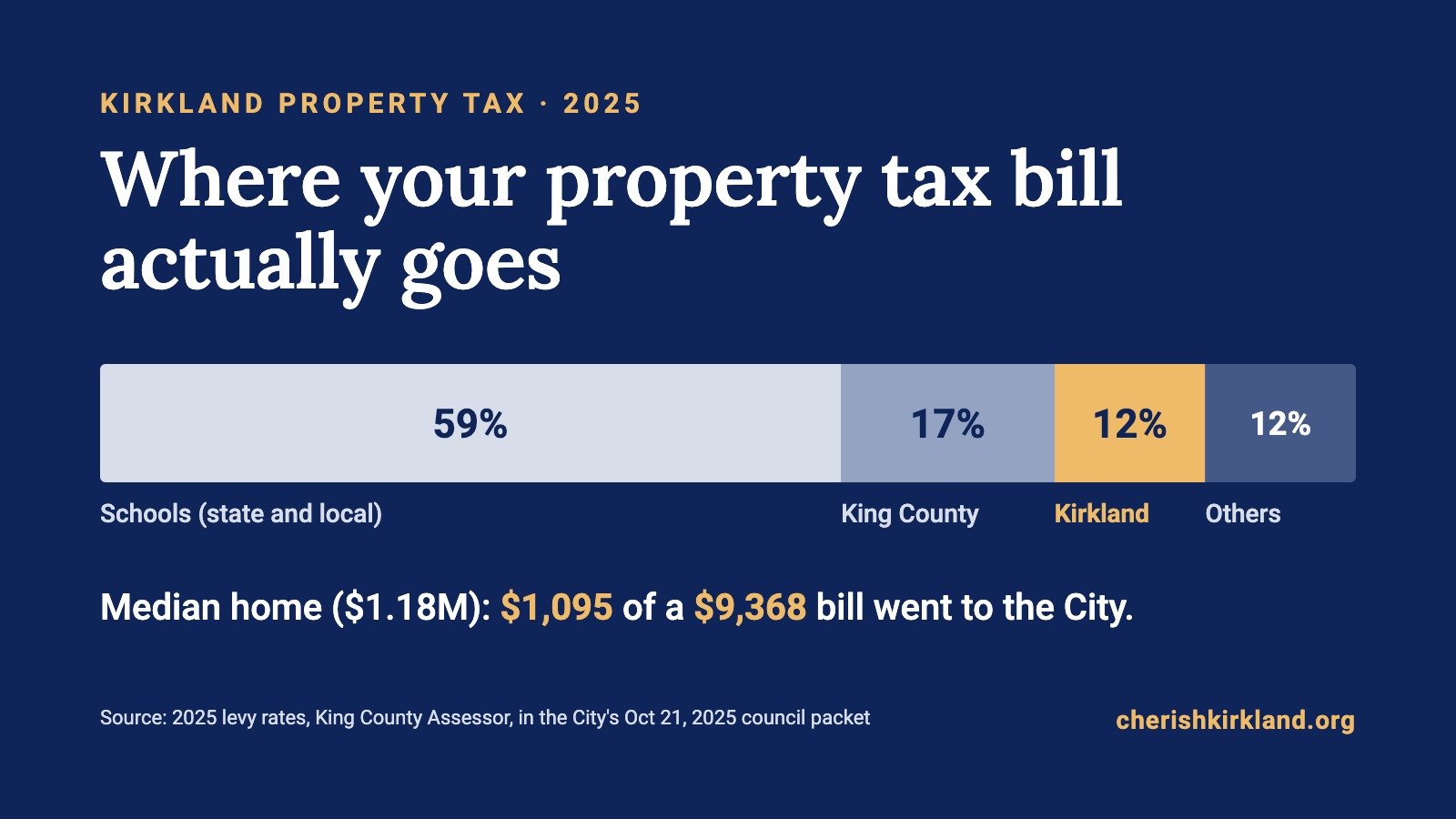
On a median Kirkland home, about 12% of the property tax bill goes to the City of Kirkland. Schools get close to 60%.
State law limits the city's total property tax growth to 1% a year, but your own bill can rise faster. This article explains why.
Kirkland projects a $6.4 million gap in its next two-year budget, about 1% to 3% of general spending a year. The city has closed a gap like this every budget cycle since 2016.
The preliminary budget comes out by October 22. That's the best time to weigh in.
Who gets your property tax
Your property tax bill from King County is really nine or ten bills in one. Each taxing district sets its own rate, the county adds them up, and you pay the total. In 2025 the combined rate on a typical Kirkland property was about $7.94 for every $1,000 of assessed value.
For the median Kirkland home, assessed at $1.18 million, that came to about $9,368 for the year. It split roughly like this:
Schools: about 59%. That's two lines, the state school levy and the Lake Washington School District's local levies.
King County: about 17%.
City of Kirkland: about 12%, or $1,095 on that median home.
Everything else: about 12%, split among the library, emergency medical services, Sound Transit, the hospital district, the Port of Seattle and the flood control district.
Your exact split depends on where you live in Kirkland, since school and hospital district lines don't follow city limits. But the shape holds everywhere: the city is one line, and not the biggest one.
Kirkland's share, about $0.93 per $1,000 in 2025, already includes four increases voters approved over the years, each for one named purpose: parks maintenance in 2002, street maintenance and parks in 2012, and fire and emergency medical services in 2020.
Why your bill rises even with a 1% cap
Washington law limits how much a taxing district's total collection can grow: 1% a year, plus whatever new construction adds. Kirkland takes that 1% almost every year. So why do bills climb faster than 1%?
Two reasons. First, the cap applies to the city's total, not to your house. If your home's value rises faster than the citywide average, your share of the total goes up. The city's own forecast memo makes this point, and it's the one most people miss.
Second, voters approve new levies. School levies, EMS, Sound Transit and others all went on the ballot at some point, and each one added a line.
The flip side is what the 1% cap does to the city. Costs don't follow that rule. They rise with wages and prices, which have climbed much faster than 1% a year since 2020. When revenue grows 1% and costs grow faster, a gap opens. That's the story of every Kirkland budget for a decade, and it's the story of nearly every city in the state.
What Kirkland's budget looks like right now
Kirkland budgets two years at a time. Every spring, the finance team projects six years out, and every spring the projection shows costs outrunning revenue. At the council's May 29 financial retreat, staff projected a $6.4 million gap in the General Fund for 2027 and 2028. If the city keeps staff positions that are currently paid with one-time money, the gap is $11.8 million.
For scale, the General Fund spends $150 million to $180 million a year. The gap works out to about 1% to 3% of that. Staff's own memo notes that every forecast since 2016 has opened with a gap and been balanced before the council adopted the budget. The city's emergency reserves are fully funded, and 2025 ended with revenue $7.2 million over budget and spending $6.6 million under.
So Kirkland is not in financial trouble. It has a gap that returns every two years and takes a bit more work to close each time.
How the city can close it
Some tools don't need a public vote. The council can take the yearly 1% property tax increase, which it usually does. Utility taxes rise on their own when Puget Sound Energy raises rates. Fees can change; one proposal would raise the school zone camera fine from $136 to $145. A new state law lets the council add a 0.1% sales tax for criminal justice, which must be in place by June 2028. And the city can spend savings, which staff say would hold services steady through 2028 but make 2029 and 2030 harder.
Other tools need voters. The big one is a levy lid lift, which asks voters to let the city collect more than the 1% cap allows. Nothing like that is on Kirkland's calendar today. Kirkland voters last saw one in November 2023, when Proposition 1 asked for a permanent lid lift of $0.28 per $1,000 (about $280 a year on a $1 million home) to build an aquatic and recreation center. It did not pass.
What a lid lift looks like: Kenmore's vote this November
If you want to see a lid lift up close, look one city north. On November 3, Kenmore voters decide their own Proposition 1. According to Kenmore's Ordinance 26-0644, it would:
Raise Kenmore's city tax rate from $0.70 to as much as $1.25 per $1,000 of assessed value in 2027. On a $1 million home, the full amount is about $550 a year more.
Let the levy grow up to 6% a year from 2028 through 2032, instead of 1%, and make the 2032 amount the base for all future years.
Fund climate and environmental programs, affordable housing through ARCH, and human services, with the council free to shift money among them.
Exempt qualifying seniors, disabled veterans and people with disabilities from the increase.
Kenmore's own estimate of the first-year increase is about $0.36 per $1,000, or roughly $360 a year on a $1 million home. The ordinance and the ballot title set the 2027 rate at up to $1.25 and allow growth of up to 6% a year through 2032. Those are the limits voters are being asked to approve, and they are higher than the estimate.
Kenmore's ordinance explains why: the city's own financial plan projects a $20.2 million shortfall by 2032 and reserves falling below its goal by 2029.
We take no position on another city's measure. It's useful here for one reason. Kenmore is asking voters to fund, permanently, the same kinds of things Kirkland's forecast currently labels "one-time": added human services funding and the city's contributions to the ARCH housing trust fund. One-time money has to be found again every budget. Whether Kirkland moves those into ongoing funding, keeps them one-time, or lets them lapse is one of the clearest things to watch this fall.
Affordable housing money is under pressure across the Eastside. In ARCH's fall 2025 funding round, 15 applications asked for a total of $14.8 million. Seven projects were funded, which will build or preserve 502 homes, and Kirkland's share of those awards was $1,261,800. Kirkland has already put a price on one version of a housing levy: a consultant study in the October 21, 2025 council packet estimated that building 210 affordable homes would cost the owner of a median home about $44 to $64 a year.
What it adds up to for your household
Most of these costs are small on their own. Together they grow, and they arrive through different bills, so few people ever see the total. The city's sample monthly utility bill goes from $262.09 today to $284.12 next year, and the city projects $423.69 by 2032. Sales taxes are rising too. Property tax is only part of the picture.
Renters see none of this on a tax statement, but landlords do. Over time, property tax increases tend to show up in rent. And the exemptions for seniors, people with disabilities and disabled veterans only help people who own the home they live in.
None of that means any single choice is wrong. A small levy for a clear purpose may be well worth it to many neighbors, and plenty of people are glad to pay more when they can see what they get. So any program in this budget, old or new, should be able to answer a few plain questions:
What result is it supposed to produce, and how will we know it worked?
What else could the same money do?
Before asking for new revenue, has the city shown what it cut or reprioritized? Kirkland's own budget rule for this cycle says new programs must come with a way to pay for them.
How much goes to preventing problems, and how much to responding once they happen?
And for households: what does the combined cost look like for a typical owner and a typical renter, and does each new dollar go where the budget says it will?
Could you qualify for a reduction?
King County reduces property taxes for homeowners who are 61 or older, or who have a disability, including veterans with a service-connected disability. You have to own and live in the home. For 2024 through 2026 taxes, your household income, after qualified expenses, has to be $84,000 or less. You can apply for past years too and get a refund if you overpaid. For 2023 taxes, October 31, 2026 is the last day to apply and still get a refund on the second half of that year. Apply or check the details at the county's senior exemption page, or call 206-296-3920.
When to weigh in
By October 22: the preliminary 2027-2028 budget is published. Look for how the gap is closed and whether human services and housing money is ongoing or one-time.
October 29: council budget work session.
Wednesday, November 4: public hearing on the budget, plus a hearing on next year's property tax levy. You can comment in person or by email to CityCouncil@KirklandWA.gov.
Tuesday, November 17: final budget hearing.
We'll cover each of these in our council previews.
Sources & city records
Last updated: October 2026.
BERK Consulting for the City of Kirkland, Multifamily Property Tax Exemption Fiscal Impacts Study (draft, October 7, 2025), Exhibits 6 and 19, Attachment 1 to City Council item 9.b, October 21, 2025 (PDF). The 12%, 17% and 59% shares are our arithmetic from the 2025 levy rates in that study.
City of Kirkland, "May 2026 Financial Update and Forecasts," memo to the City Council Financial Retreat, May 29, 2026 (the $6.4 million and $11.8 million figures are restated in the September 15, 2026 memo below; the retreat packet is available through the council meetings page)
City of Kenmore, Ordinance 26-0644 (Proposition 1 levy lid lift) and staff presentation, in the June 15, 2026 City Council agenda packet (PDF)), and the city's Proposition 1 information page. The $550 figure is our arithmetic from the ordinance's rates.
King County Assessor, Senior Exemption Program, qualification details
Want to talk about this with neighbors? Join the Cherish Kirkland Facebook group. It’s a private community of Kirkland residents; request to join, answer the membership questions, and an admin will approve you.