
Downtown lot parking doubles to $2 an hour and adds Sundays, and Houghton and Juanita beaches start charging in summer, both settled by the budget vote. The average utility bill rises 8.4% next year. The City has $616,000 uncommitted, and two costs flagged after the City's budget document went to print could use all of it. Three neighborhood safety projects were left out. The four services residents rate important but grade low get less than last time. And a council member asked for early changes to the Neighborhood Safety Program.
Thursday, October 29, 2026. Special meeting, 3:00 PM, City Hall. Four and a half hours on the $1.15 billion two-year budget and one vote, 6–0, to excuse Councilmember Tymczyszyn, who arrived an hour in. Councilmember Arnold attended by video. Timestamps are hours:minutes into the video on the City's meeting page.
The Short Version
About two minutes here, eight for the full recap. The budget is balanced with about $20 million of one-time money that won't be there next time. Hearings November 4 and 17, adoption December 8.
IN THE BUDGET UNLESS REOPENED
Paid parking. Downtown lots go from $1 to $2 an hour and add Sundays; Houghton and Juanita beach lots charge $1 an hour in summer. The revenue is already counted, so the budget vote decides it. (Penny tax and parking)
CUT, THEN QUESTIONED
Three safety projects were left out: a neighborhood speed limit pilot ($180,000), school zone upgrades ($544,000) and park cameras and gates ($358,000). Council members want another look. The uncommitted money is $616,000. (Matching the priorities)
SEVEN MINUTES
The four services residents rate important but grade low get $11.2 million, 2.9% of the operating spending the City's chart maps, down from $11.9 million. Staff opened the slide with "We don't have to spend as much time with it." Councilmember Pascal said he'd look for what would "move the needle." Councilmember Falcone said the survey asks residents while the City also serves people who work, study or hope to live here. No one proposed moving money. Traffic flow has sat in that box since 2008. (Matching the priorities)
TEED UP FOR JANUARY
A first possible change to the Neighborhood Safety Program: a project cap and a sit-out year, which the City Manager said could be ready for a January meeting. Councilmember Arnold also asked "whether organizations other than neighborhood associations could sponsor projects." The structure question waits for the first quarter. (Neighborhood Safety Program)
RAISED, NOT PURSUED
A downturn. Staff said the forecast assumes "things are as normal" and that economic risks "largely" aren't accounted for. No council member followed up. (The economy)
DIRECTION GIVEN
Five of seven council members said yes to the penny sales tax King County is imposing April 1. Adopting Kirkland's own keeps about $420,000 a year here for human services. Vote December 8. (Penny tax and parking)
REPORTED
Public records will cost about $1.5 million over two years, up from $1.3 million. Staff named "the emergence of AI." (Public records)
TEN ITEMS, A DOZEN MORE
The work program. The City Manager proposed ten items, "finishing what we've started." Council members suggested about a dozen more, each with a likely cost. (Item 4.A)
If you only have time for one thing: beach and downtown parking are decided by the budget vote on December 8, and the three safety projects compete for the same $616,000. Email before then. If you also care who gets to propose neighborhood safety projects, that comes up in January. CityCouncil@KirklandWA.gov
Where Your Email Counts Next
Written comments become part of the public record. Email CityCouncil@KirklandWA.gov. Our guide to commenting in writing has the details.
November 4, 5:30 PM study session, 7:30 PM hearings. The capital program, the transportation work plan, school zone camera sites, the first budget hearing and the yearly hearing on next year's property tax levy. That levy is the 1% increase council can take without a ballot measure, not a new tax.
November 17, 5:30 PM and 7:30 PM. The 0.1% public safety sales tax study session, the second budget hearing, council deliberations, and the first vote on next year's property tax.
December 8. Adoption of the budget, the capital program and the penny tax ordinance.
January. Council is expected to take up a project cap and sit-out rule for the Neighborhood Safety Program. The program's structure comes in the first quarter.
Matching the priorities to the city survey
One of the City Manager's tests for a budget is whether it answers community priorities, measured by the resident survey and plotted on a chart the City calls the Kirkland Quad. Services rated important and graded well are Stars: fire and EMS, police, parks, streets, garbage. Services rated important but graded below average are Imperatives: traffic flow, planning and growth response, attracting and keeping businesses, and neighborhoods. The chart puts $311.2 million of operating spending on the Stars, 82% of what it maps, and $11.2 million on the Imperatives, 2.9%. The Stars gain $24.4 million as garbage, police, fire and streets cost more. Capital projects, where most road work sits, aren't on the chart.
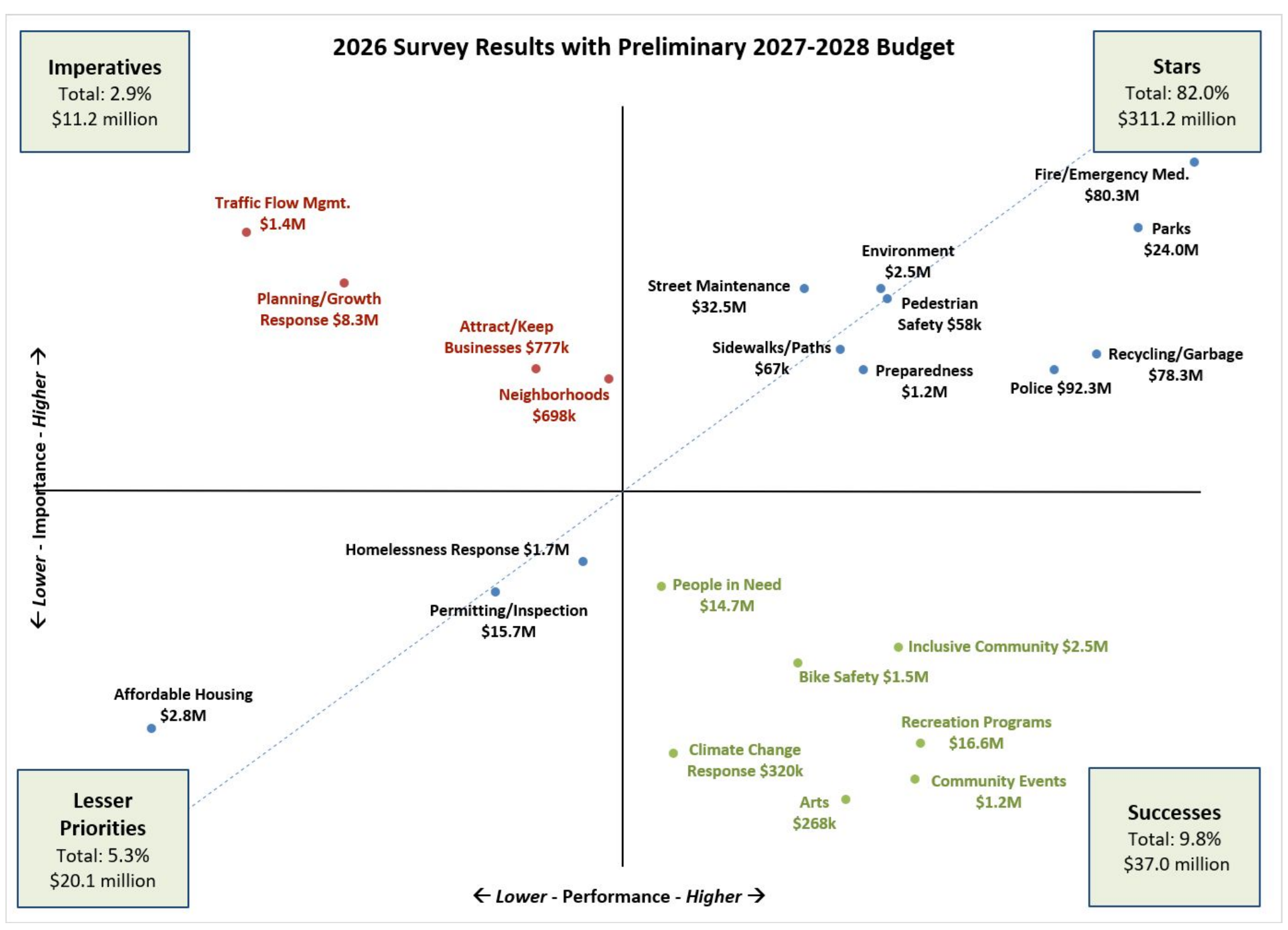
The Kirkland Quad from the City's 2027-2028 preliminary budget, page 123. Importance runs up, performance runs right, and the red dots are the Imperatives. Source: City of Kirkland.
1:38 to 1:46. The Quad took about seven minutes of a four-and-a-half-hour session and ended at the break. Staff introduced the spending slide with "We don't have to spend as much time with it." Councilmember Pascal, reading it: funding for the Imperatives "goes from 11.9 million down to 11.2. Correct?" Staff: "Correct." Pascal called it "2.9% of the total" and said he'd be looking at "what are those things that we can do to move the needle." Staff said the 2025-26 figure included one-time money. Councilmember Prem asked what "planning and growth responses" means; definitions come in November. No one proposed moving money.
The same box since 2008
The City built the Quad to make sure it "provides the services that matter most to the community." Its survey report says improving the Imperatives is "likely to have the greatest impact on improving residents' overall favorability of the City." The box has held the same services through surveys by different firms. Elway's 2008 survey put traffic flow and zoning and land use there; EMC's 2022 survey and the 2021 and 2024 charts had traffic flow and growth response; this year's survey, fielded by a third firm, found the same two "among the most important services to residents" with "some of the lowest performance ratings." In 2009 the City laid its budget over the chart, found 84% in the Stars and 5% in the Imperatives, and wrote that spending "closely aligns with the community's priorities." The share since: 3.6% on the 2025-26 chart, 2.9% now.
What the packages show
Departments asked for 66 service packages worth $18.5 million. The City Manager left out seven worth $1.6 million, three of them safety projects:
Park security cameras and gates, $358,000
School zone enhancements, $544,000
The neighborhood speed limit pilot, $180,000
By our reading, the speed limit pilot and the school zone work are the kind of neighborhood traffic items the red box describes; the City hasn't said which category it would file them under. Recreation, which the City files under Successes, services residents grade well but rate less important, gains almost $4 million, mostly to run the new community center opening in 2028. He added $603,000 of his own: a higher human services grants base, which council had pushed for, and a larger ARCH contribution. Thursday Councilmember Arnold asked whether cameras and gates could be split and the Mayor said she'd like to see that, Pascal asked which school zone pieces could go ahead, and the City Manager will square the speed limit work with council's direction on November 4 and 17. He will "keep a running tally" against the $616,000.
Who the survey asks
At 1:45, Councilmember Falcone, "more of a comment than a question": the survey "is specifically people who are residents," which "includes both renters and homeowners," and "a lot of the issues that we work on that are in the lesser priorities may not really impact current residents as much, but other people who may be future residents," people who "work here" or "visit here," and "folks who can't yet afford to live here. So for example, see that affordable housing dot pretty far to the left and down there. The importance of that may not be as high because folks who are already residing here [...] a lot of folks are still struggling financially but currently are able to live in the city of Kirkland." No one responded.
Our read. Councilmember Falcone is right that the survey asks residents, renters and owners alike, and that the City also serves people who work, study or hope to live here. That's a fair caution about one chart. It doesn't answer the question Councilmember Pascal put on the table. The Quad is the City's test of whether a budget answers community priorities, and the four services in the red box are the ones its method says deserve the closest look. Part of the small share is the chart itself: it maps operating spending only, so road and signal projects sit outside it, and business recruitment and neighborhood services are small programs. Even so, these four have sat in that box since at least 2008, and this budget gives them less while the Stars gain $24.4 million. If council weighs other goals above the survey, the hearings are the place to say so, rather than letting the chart go by in seven minutes. The City Manager writes the proposal; council votes it and can move any dollar. The question for November 4 and 17 is what would move one of the four out of the box, and what the $616,000 and the 0.1% tax buy.
Why weigh in now → The three safety projects, a $106,000 traffic-signal AI pilot and a quarterly newsletter (about $70,000 more) compete for the same $616,000 before December 8.
3B — The budget at a glance: balanced on one-time money, no votes
0:02 to 0:49. $1.15 billion total, a $361.9 million General Fund, no new general taxes beyond the 1% property tax increase, every reserve funded. The base budget starts $10.6 million short. With the Kraken Iceplex community center, the structural gap is $19.7 million for 2027-28, closed with one-time money, and $24.3 million in 2029-30. Labor costs grew $21.4 million, more than all ongoing revenue growth. Public defenders, the lawyers the City must provide for people who can't afford one, roughly double in cost under state caseload standards. Utility rates adopted October 20 raise the average bill 8.4% in 2027 and 8.35% in 2028; our household guide covers what the budget means for your bills.
1:19 to 1:36. Conservative budgeting left $14.8 million of one-time money from 2025-26, mostly empty positions and sales and utility tax above budget. After the base gap, the packages, a $750,000 police grant match and $4.9 million of ambulance reimbursement reserves, $616,000 is left. Then the "things change" slide: a jail medical contract now put at $350,000 to $400,000 a year, and Evergreen EMS levy money about $93,000 a year under budget. Councilmember Arnold pointed out both are yearly figures against a two-year cushion, so together they could pass $616,000. Staff agreed, and said salary savings or the public safety tax might cover the jail cost.
Why weigh in now → Which of council's additions gets the $616,000, and which waits for 2029, is decided before December 8.
The economy the budget assumes
The budget document says its cautious habits work "in a normal economic environment." Staff said so twice Thursday. At 1:27, on the 2029-30 gap: "We're assuming things are as normal." At 3:21, the "storm clouds" slide: inflation, interest rates, state budgets, global conflicts and AI "add uncertainty and potential risk in the 27-28 budget that largely isn't accounted for," plus a proposed federal cap on ambulance reimbursements from 2029 and one gambling business whose loss would mean "about a $3.2 million cut." No council member followed up. The document itself says tech layoffs have pushed Kirkland's unemployment above the national average and home values fell 8.88% from March 2025 to August 2026 by Zillow's measure. On October 26, KUOW reported, Microsoft offered buyouts to about a quarter of its workforce.
Our read. The City has built for a slowdown: sales tax held flat through 2028, every position budgeted as filled, and $13 million in rainy-day and revenue stabilization reserves, untouched. The risk is in the one-time money. Of the $14.8 million, $4 million was sales tax above forecast and $2.5 million was utility tax from rate increases staff say isn't likely to keep growing at the same pace. A soft two years means less of that next time, when the gap is already $24.3 million. The $4.5 million estimate for the 0.1% public safety tax assumes sales tax grows 3.5% a year.
Why weigh in now → November 17 is the place for a downturn case, before council weighs a tax whose estimate rests on 3.5% growth.
Neighborhood Safety Program: who gets to propose projects
Since 2014 neighborhood associations have proposed transportation safety projects, a neighborhood panel and a staff panel have scored them, and council has approved the winners: 89 built on a $350,000 base, with the $75,000 cap often exceeded. The issue paper says the program "was originally intended to re-energize neighborhood associations and strengthen their engagement with the City." The budget raises the base to $425,000 and asks council to pick a structure: keep the program and enforce the cap (Option A); keep it but make a neighborhood that wins more than the cap sit out the next year (B); replace the yearly competition with a four-year rotation, three or four neighborhoods taking their turn each year (C); or copy Bellevue (D), splitting the city into four quadrants with their own allocations, widening the scope to landscaping, playgrounds and cleanups, and taking projects from "residents, neighborhood organizations, and other organizations," with associations "no longer the exclusive or primary decision-making structure." Under any option, council could let "schools, PTSAs, nonprofit organizations, business organizations, and other established community groups" champion projects. Staff recommend no structural change before 2028.
3:47 to 3:52. Councilmember Pascal asked whether the options get decided in the budget or later. The City Manager: 2027 runs as is; structure can wait for the first quarter. Councilmember Arnold asked to go sooner "even though the program itself doesn't change" on over-budget projects, later-year eligibility, and "whether organizations other than neighborhood associations could sponsor projects." The City Manager said "a modest change could absolutely be done by the end of the year," naming the cap and sit-out year for the first or second meeting in January. He didn't say whether the sponsor question would be part of it.
OUR VIEW. The paper's own goals are the right test: safer streets and a fair spread of projects, with neighborhood associations stronger for the work. The program has fallen short on the first two. Totem Lake has had two projects in twelve years to Finn Hill's seventeen, a neighborhood with no active association has no way in, and the schools, PTSAs and businesses the program was meant to work with never got involved, all fair criticisms. Our answer is to fix them inside the association model. Let a PTSA or business group bring a project to its neighborhood association and help carry it, and write that into the program guide in January. Use Option B or C to spread projects around, and hold back a share of each year's budget for neighborhoods that haven't been funded in years. Option D would also fix the spread, at the price of taking the one program that gives a neighborhood association a job to do and handing it to a wider pool. A PTSA that wants a safer walk to school is where a neighborhood like Totem Lake finds its next association leaders, if the program sends it there. Our neighborhoods page lists every association and how to reach it.
Why weigh in now → The cap and sit-out rule come in January and the structure question in the first quarter. Whether other groups come in through associations or alongside them is open.
Public records: what it costs
2:05. City ordinance has council set, every two years in the budget, how much effort goes into public records. Staff reported:
2025-26 cost: about $1.3 million
2027-28 budget: about $1.5 million, up about 15%
A $150,000 addition to the Public Disclosure Reserve, bringing it to $250,000, to keep a temporary analyst through 2028 and cover "workload, staffing, litigation, or other significant public disclosure needs"
Staff said demand keeps rising and "the emergence of AI has helped folks put in more and sometimes more time intensive requests." They were "not particularly looking for any council direction" and moved on. Earlier, at 0:45, the City Attorney's office told Deputy Mayor Black that "we try not to engage in public records litigation that some of our peers might engage in, that can cost money and not be covered" by the cities' insurance pool.
Our read. The record doesn't say what the requests are about or how long they take; fair questions for November 4. Our records request guide explains how to ask.
Why weigh in now → If you've waited months for a request, the November 4 or 17 hearing is the place to say so.
The penny tax and paid parking
0:58 to 1:10. King County adopted a 0.01% children-and-families sales tax effective April 1. A city that adopts its own gets its share credited back, so receipts don't change. Kirkland's share is about $420,000 a year once running. Councilmember Pascal: "either we let King County decide how to spend it, or we decide how to spend it." Falcone, Black, Arnold and the Mayor agreed. Tymczyszyn said he hadn't formed an opinion; Prem didn't say. Vote December 8.
2:01, 2:30, 2:43 and 3:48. Parking: the two downtown lots go from $1 to $2 an hour and add Sundays, and Houghton and Juanita beach lots charge $1 an hour in summer. On-street changes are "not recommended." Councilmember Pascal repeated questions about Juanita Beach parking he said he never got answers to. Asked whether parking comes back later, the City Manager said it's in the budget because the revenue is assumed: "If council wants to make a different decision, we just need to adjust that in the budget process."
Why weigh in now → Beach and downtown parking are settled by the budget vote on December 8.
4A — Work program: ten items in, a dozen more suggested
3:58 to 4:26. The City Manager proposed ten items, "not doing more and more, but sort of finishing" what the City has started: the Iceplex community center, the Kingsgate site, human services targets, a fire strategic plan, permit streamlining, street and sidewalk funding, a possible minimum wage study (council decides November 4), and a sustainable budget plan for the May 2027 retreat, where staff will need direction "to start to be cutting or reducing," or to find revenue, or both. Council members added speed limits, the Totem Lake station area ahead of bus rapid transit in 2028, the transit needs study, Peter Kirk Pool and a pool at Kingsgate, an AI policy and AI for traffic flow, an economic development strategy, the Cross Kirkland Corridor, and the DEI update, which the Mayor said council hasn't seen. The Mayor: "we're going to make it longer." Work programs usually run 12 to 14 items, the City Manager said, and each tends to bring a cost. Adoption is January through March.
Two additions came with an argument. Councilmember Arnold called the station area the next Totem Lake: "if we get major development there, that also helps us close that 29-30 gap." On human services, Deputy Mayor Black said Kirkland is "behind a lot of our peer cities from a per capita standpoint, not all of them. We're kind of in the middle of the road." The issue paper bears that out: about $26 per resident in grants for 2027 by our math, or $31.89 by the City's broader count, against Bellevue's $43.96 and Redmond's $42.70, with five smaller neighbors between $9 and $17. Councilmember Falcone said residents see "a huge piece" of the pie chart going to police and fire and "this tiny piece that goes to human services."
Our read. Totem Lake's development is already in the revenue base, and the budget still shows a $24.3 million gap. If station area growth is meant to help close it, the forecast should say how much and when. On the pie chart: police and fire are the biggest pieces because they are the biggest payrolls, and the budget document puts their $14.2 million increase down mostly to salaries, personnel costs and professional services. Residents also rate fire and EMS the most important service the City provides, and calls rose 2.4% in Kirkland from 2024 to 2025 while they fell 3.23% across the region. Councilmember Arnold asked about the fourth firefighter discussed under Proposition 1 for Station 24; the City Manager said the decision was made in 2024 and the Chief said a data review is under way.
Also Thursday
Police grant and the 0.1% sales tax
2:17 and 3:28 to 3:45. The City won the state ESHB 2015 grant: about $1.2 million, mainly for six entry-level officers plus a jail navigator and officer wellness screening, through June 30, 2028. Keeping them afterward is one argument for a 0.1% public safety sales tax, about $4.5 million a year, a dime on $100; the 2029-30 gap and public defender costs are others. Study session November 17.
Human services and ARCH
Grants total $5.28 million for the two years, with $433,000 of state money moved into the ongoing base. The City's contribution to ARCH's housing trust fund rises to $1.43 million, paid mostly by the new fee on homes over 2,000 square feet.
Iceplex center
The Iceplex community center costs $5.3 million over two years, opening January 2028, with program fees covering about two-thirds of operations and summer beach parking on top.
What To Watch Next
Our question for the hearings: the Quad has flagged traffic flow since 2008. What in this budget moves it, or any Imperative, out of the box? And who does council treat as the neighborhood's voice, on the survey and in the Neighborhood Safety Program?
Also coming back: the fourth-firefighter data review; a transportation work plan squared with council's speed limit direction; the survey definitions Councilmember Prem asked for; which Imperatives figure is right, $11.9 million on the October slide or $12.5 million on the May one; and whether anyone brings a downturn case November 17.
Prepared by a Kirkland neighbor from the meeting video on the City's meeting page, with figures checked against the 2027-2028 preliminary budget, the budget issue papers and the October 29, 2026 agenda. Timestamps are hours:minutes into the video. Where a figure is our own arithmetic on the City's numbers, it is labeled as such. Quotes are as heard on the video, with filler words removed and cuts marked; names and numbers can be hard to catch, so check the official minutes before quoting anyone.
Sources & city records
City budget documents page: the 2027-2028 preliminary budget, service packages and issue papers
2027-2028 Issue Papers: Human Services at IP-14, Neighborhood Safety Program at IP-115 (PDF, 9 MB)
2026 Community Survey page, with the May 29 presentation and the Kirkland Quad
Fire call figures: the November 5, 2025 packet (NORCOM assessment) and the February 17, 2026 packet, on the City's council meeting agendas page
KUOW, October 26, 2026: Microsoft offers voluntary buyouts to a quarter of its workforce
Want the preview before the next meeting? Members of our private Facebook community get every meeting preview days before the council meets, while there's still time to email council and shape the outcome. Join the Cherish Kirkland Facebook group. Request to join, answer the membership questions, and an admin will approve you.
Prefer email? The Council Preview arrives a few days before each council meeting. Sign up for the Council Preview email.
