
EXPLAINER · PROCESS
How to Read a Kirkland Council Packet
How an issue works and who decides it. We keep these up to date. About our labels
Before every City Council meeting, the city posts the documents behind each decision. You don't need special training to read them, and you don't need to read all of them. This guide shows you where to start.
In short:
The packet posts on Friday around 4 p.m. for a meeting that starts Tuesday at 5:30 p.m. You can have the agenda emailed to you.
Start with the agenda, pick one item, and read the first page of its staff memo. That takes about twenty minutes.
If you want to go further, do what we do: add up the numbers and look up what the council decided before.
Your first packet in twenty minutes
Open the agenda. It's the first few pages of the packet and works like a table of contents. Every item has a number, such as 3.a or 9.b.
Pick one item. Choose something that touches your street, your bill, your park or your kids' school. One is plenty.
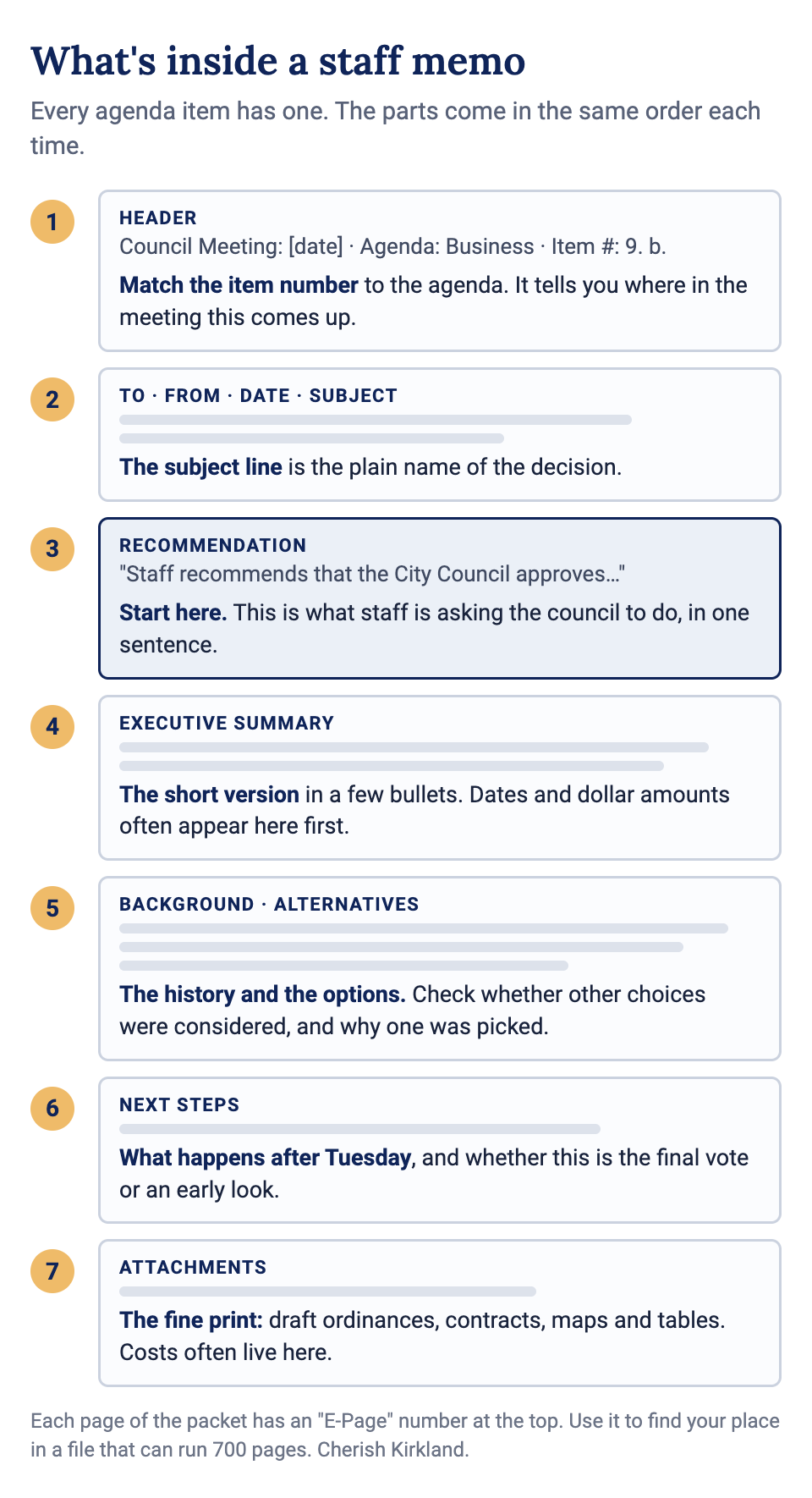
Find its memo. Search the file for a word from the item's title (Command+F on a Mac, Ctrl+F on a PC). Each memo starts with a header that shows the item number.
Read the recommendation. It's near the top of the memo and says in one sentence what staff is asking the council to do.
Read the executive summary. A few bullets give the short version, often with the key dates and dollar amounts.
Decide what you think. If you have a view, you still have time to share it before Tuesday. The last section of this guide explains how.
That's it. Everything after this point is for when you want to dig deeper.
When the packet arrives
Kirkland's City Council meets on the first and third Tuesday of most months at City Hall, 123 5th Avenue. A study session starts at 5:30 p.m. and the regular meeting follows at 7:30 p.m. The packet usually goes up the Friday before, around 4 p.m.
That leaves a weekend and a Monday to read it, work out what it means for you, and let the council know what you think. It's a short window, and the chance to give feedback is just as short. If one item matters to you, reading it early does more good than reading the whole packet.
To have agendas emailed to you, go to the city's email subscription page, enter your email address, and check the topic for City Council agendas. Current and past agendas, packets and meeting video are on the city's Council Meeting Minutes and Agendas page.
Be ready for the size. A packet can run to several hundred pages. Each page carries an "E-Page" number at the top, which helps you keep your place.
One thing is missing. The slides staff show at the meeting are not in the packet, so residents first see them on screen on Tuesday. In our view, that's unfortunate. The slides are often the clearest summary of an item, and by the time they appear, most of the chance to comment has passed.
What's inside a staff memo
Every item on the agenda has a staff memo, and the memos follow the same pattern. Once you know it, you can find what you need in any of them.
Words you'll see
Study session: an early, informal discussion. The agenda itself says no official action can be taken at a study session.
Consent calendar: routine items approved together in a single vote, usually with no discussion. Routine doesn't always mean small, so it's worth a skim.
Business: items discussed and voted on one at a time.
Public hearing: a formal chance for the public to speak on a specific item before the council decides.
Ordinance: a local law. It's the most permanent kind of council action and can only be changed by another ordinance.
Resolution: a statement of council policy, or direction to staff. A later resolution can change it.
Quasi-judicial: a decision about one specific property, where the council applies existing law to the facts. Public comment isn't taken when the council considers these.
Capital Improvement Program (CIP): the city's six-year plan for big projects like roads, pipes and parks.
General fund: the city's main budget for everyday services, from police to parks.
Executive session: a closed session the council may hold only for purposes the law allows, such as property deals, some personnel matters and litigation.
What happens on Tuesday
The meeting opens at 5:30 p.m. with the roll call and the study session. At 7:30 p.m. the regular meeting picks up with any proclamations, followed by "Items from the Audience," the general public comment period.
In Items from the Audience, each speaker gets three minutes. The period runs up to 45 minutes, and no more than six people can speak on any one subject. You can talk about almost anything, whether or not it's on that night's agenda. The exceptions are items scheduled for a public hearing, which have their own time to speak, and quasi-judicial matters, which don't take comment.
After that, the council holds any public hearings, passes the consent calendar, and works through the business items. Meetings are broadcast live and can be watched later on the city's website.
Reading like we do
Most of what we find comes from two habits: we add up the numbers ourselves, and we look up what happened before. Neither takes special skill. Mostly it takes curiosity.
We add up the numbers
Memos tend to give numbers in pieces: a rate change here, a percentage there, a total in a table at the back. We put the pieces together and ask what they mean for one household.
If a memo says a rate will rise 8%, find out what the typical bill is today and work out the new bill in dollars. If it shows one year, look for the years after it, since many proposals include a projection several years out. If the total comes from more than one source, such as a rate, a tax and a fee, add them up so you can see the whole amount.
Then check the memo's words against its own tables. A summary might say something doubled when the table shows it grew by half. That's still worth knowing, but it's a different claim.
Good questions to carry with you:
What will this cost a household, per month or per year?
Is it a one time cost or an ongoing one? Who pays: rates, taxes, fees or grants?
Where does the money go, and can it be used for something else later?
Does the summary say the same thing as the table?
What's missing? A funding list with no count of who it serves, for example, or a cost with no end date.
We look up the history
Very little on an agenda is truly new. Before we write about an item, we go back through past agendas, minutes and meeting video to see what the council did the last time something similar came up.
The city's agenda page lets you open past meetings and search their materials. Look for the same topic, the same property, or the same program by name. The memo's background section often mentions earlier decisions, and those are good places to start.
Questions worth asking:
Has the council done this before? What did it decide, and how did it get there?
Does this item change or undo an earlier decision?
Is the city following its own adopted policy, or making an exception to it?
Is the usual process being followed this time, such as a hearing, a commission review, or a vote to schedule the item?
Where did the idea start: with staff, a councilmember, or a new state law?
We follow the ripples
A decision in one item often shows up later somewhere else. A new facility can mean a road, sewer or parking cost that appears years afterward in the capital plan. A change to the zoning code can affect traffic, schools and parks well beyond the lot it was written for.
Scope matters too. Read exactly who a rule covers: the whole city, one zone, one neighborhood, or one project. Getting that right keeps you from missing something that affects you, and from overstating something that doesn't.
Things to wonder about:
What else does this touch: traffic, schools, parks, utilities, taxes?
Who does it apply to? The whole city, one zone, or one project?
Is there a placeholder, a study still "to be determined," or a phase two?
Is this the final vote, or an early look? When is the last chance to comment?
Share what you think
Email the council. One message to citycouncil@kirklandwa.gov reaches all seven councilmembers. Name the item number, say what you'd like the council to do, and keep it short. Try to send it by Monday so there's time to read it. Our guide to commenting in writing has more tips.
Speak at the meeting. Our guide to speaking at a council meeting walks you through signing up and what to expect.
Watch. Meetings are broadcast live, and the video stays up afterward.
Tell us what you find. Neighbors who read packets catch things we miss.
Of course, you don't have to do all of this on your own. As long as we're needed, we'll keep reading the packets and sharing our previews in our Facebook group before each meeting. So if the weekend gets away from you, we've already done some of the page turning for you.
Prefer your inbox? Get the Council Preview by email, a short version that arrives a few days before each council meeting.
Sources & city records
Last updated: October 2026.
City of Kirkland, City Council page: meeting days, times and location
City of Kirkland, Subscribe to Kirkland Email Lists
City of Kirkland, Council Meeting Minutes and Agendas
City of Kirkland, City Council meeting schedule (PDF)
City Council agendas: the meeting order, the rules for Items from the Audience, and the agenda's own definitions of study sessions, ordinances, resolutions, public hearings, quasi-judicial matters and executive sessions
Want to talk about this with neighbors? Join the Cherish Kirkland Facebook group. It’s a private community of Kirkland residents; request to join, answer the membership questions, and an admin will approve you.